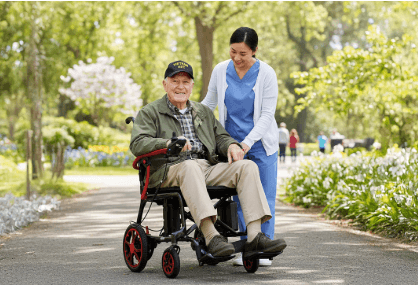
Four Million+ Australians with Disability & Reduced Mobility – No Longer Confined! While around 4.4 million Australians live with some form or degree of disability, and nearly 1 in 8 Australians report some mobility limitation (13%), it’s an outdated view that people with disabilities and reduced mobility are unable to live full and independent lives confined to their homes and reliant on others for assistance. Fortunately support products specifically designed with mobility impaired people in mind are available to provide the exact level of support, assistance or independence people with disability need to give them back control, confidence and independence to live life as they wish.
The psychology of maintained independence
When people think of losing independence as they get older, they often imagine physical changes. But there is also a psychological and emotional impact to consider. Many older people value the simple things in life – going shopping, collecting papers from the doorstep, visiting a friend for a cup of tea. These activities are an integral part of daily life and are often what give people a sense of purpose and value. Losing these things can be distressing and affect not only how people see themselves but also how they interact with others. It can also affect their health – physical and mental.
Our range of products all work together to support mobility and reduce the constraints imposed by illness or accident. They help to empower individuals to make choices as to whether or not to go out, where to go to and how long to stay there. Something that seems to us to be made of small differences such as whether you are confined to bed, then confined to a wheelchair and supported by a walking frame, as opposed to supported by a walking frame whilst remaining mobile and able to go wherever you choose for as long as you like. These small differences make big differences to quality of life.
There is growing evidence that supporting people with disability to have greater control and autonomy in their lives is beneficial for their life satisfaction and mental health, regardless of the level of physical disability they have. Independence is a continuum and rather than seeing someone with disability as being less independent because they require support, the emphasis should be on supporting people with disability to maximise their ability and live a life of dignity and participation in the way that best meets their needs and goals.
Mobility aids as confidence builders
For older adults and those with a mobility disability, one of the main barriers to their activity levels is their fear of falling. In some cases, this fear is greater than the person’s impairment.
Many people are reluctant to visit the local shops, community centres or visit friends and family for fear of taking a tumble and getting injured. Once the underlying reason is identified as a fear of losing mobility and becoming isolated is found to be more limiting than the physical restrictions then a well fitting rollator walker can soon put things right allowing you to get on with living life as you wish. Whether you require a stylish rollator to venture out with or more solid and traditional walker for use around the home for added stability, we have a wide range to suit including walkers and rollators from brands including Trekker Traum, Walkin’ Shoes and SureStep.
This increased confidence could encourage people to venture further afield from their homes to engage in more activity. This increased activity could help to maintain muscle strength and help to improve balance and reduce risk of falls. Many people who use walking aids to aid mobility have commented on how their confidence in using them has increased, enabling them to walk further distances and tackle more demanding terrain.
While having the right frame and equipment is important, it is useless if you don’t have the confidence to use it on the road. However, it is also important that the walking aid i.e. walking stick or wheelchair be matched with the correct equipment and frame that will support the individual and not put them at risk of a fall increasing their lack of confidence.
See also: Dallas to Hyderabad Flights: A Complete Guide for the Texas Indian & Telugu Community
Practical freedom in daily routines
Most people find meaning in their lives through their daily routine. However, having a disability can put a stop to these plans. People in wheelchairs cannot just pop into the shops for milk or whatever on a whim, a trip to the doctor becomes a struggle involving arrangements for a nurse or family member to push them in cars, or even take them by car. Visiting friends and family becomes a difficult and time consuming process.
When looking for mobility support products it is often helpful to consider the level of independence that the product is going to allow you. Having a walking frame with a shopping basket means that you can go shopping at times to suit you and go at your own pace. You can pick up things you hadn’t planned on buying and then pop back home to put them away. In many ways it is business as usual.
Social connection and community engagement
Despite their desire for social interaction, many people with disabilities are socially isolated because they lack the mobility to go into the community, home or other settings where they might encounter others. Mobility to shopping malls, theaters, churches, synagogues, mosques, community centers, restaurants, etc. are some of the settings where many community and social activities take place. These individuals could be out interacting with others if they were able to get around.
Having a mobility aid can enable you to go out into public places again. Go to your grandchild’s school concert, attend community meetings, visit with friends and family, or just take a walk in the park. These contacts are more valuable than any cure for medical mobility limitations and can prevent social isolation resulting from mobility decline.
Long-term health preservation
Regular exercise is critical in preventing the loss of bone density, reducing the risk of heart disease, and protecting brain function with age. Our supported mobility products allow individuals the freedom to remain active and ambulate unassisted whenever safe and practical to do so. Without these products, individuals often become less active, and allow different systems of the body to deteriorate.
Safe mobility is critical to ensure that older adults maintain their mobility and delay age-related decline. In addition to health benefits, users of assistive mobility devices require less assistance from others and less formal care. They are able to live independently longer, and to continue to contribute to their families and communities. Although the greatest value of good mobility support products is to their users, there is also a significant economic return.