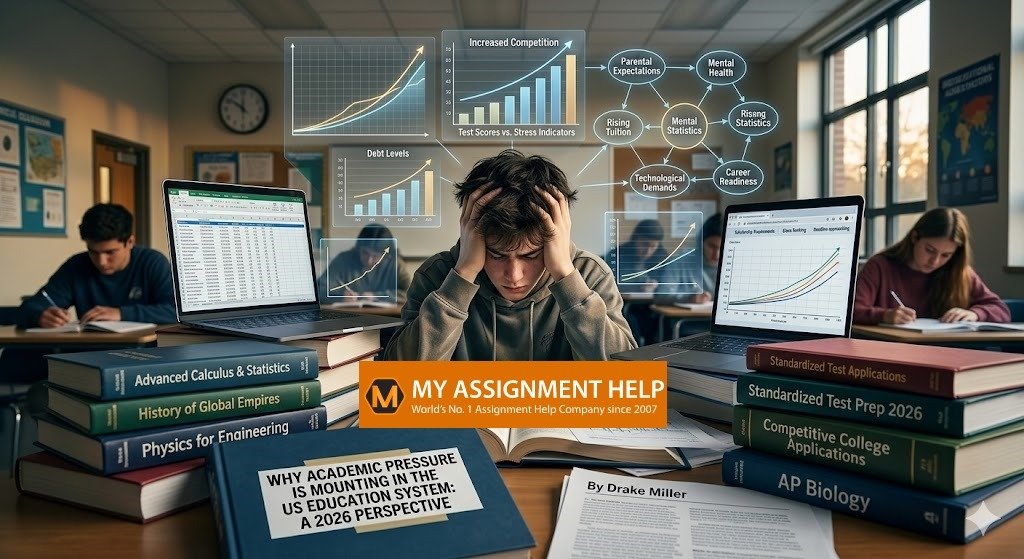
For generations, the American classroom was viewed as a land of opportunity—a place where hard work translated directly into upward mobility. However, for today’s high school and university students, the atmosphere has shifted from one of exploration to one of high-stakes survival. Across the United States, from the competitive suburbs of the Northeast to the tech-focused corridors of the West Coast, students are reporting unprecedented levels of stress, anxiety, and burnout.
The question facing educators, parents, and policymakers is no longer if students are under pressure, but why that pressure has reached a boiling point. Understanding the systemic drivers behind this trend is essential for navigating the modern academic landscape.
1. The “Credential Inflation” Phenomenon and the 2026 Job Market
One of the primary drivers of academic stress is the diminishing value of a standard degree. In decades past, a high school diploma or a general bachelor’s degree was a reliable ticket to a middle-class career. Today, “credential inflation” means that entry-level positions often require advanced degrees or specialized certifications that were previously unnecessary.
In 2026, the integration of AI and automation in the workplace has raised the bar even higher. Employers now look for Digital Skills and Agentic AI Literacy as baseline requirements. This forces students to not only “pass” their core subjects but to simultaneously earn micro-credentials in data science, coding, or digital strategy. For those navigating complex quantitative requirements, seeking specialized help with statistics assignment can be a crucial step in maintaining a competitive GPA. This has turned education into a zero-sum game where being “average” is perceived as a failure.
2. The Quantification of Success: Standardized Testing and the College Board
While the “test-optional” movement gained some traction during the early 2020s, the US education system remains deeply rooted in quantification. From the digital SAT and ACT to state-mandated proficiency exams, students are taught from a young age that their worth is tied to a three-digit score.
This focus on testing often leads to “teaching to the test,” which strips the joy and creativity out of learning. In high-stakes vocational tracks, the pressure is even more intense. Students in medical pathways, for instance, often require nursing assignment help to manage the rigorous documentation and clinical theory required alongside their practical exams. When the stakes of a single exam include Ivy League admissions or scholarship eligibility, the resulting physiological and psychological stress can be paralyzing.
See also: How Can Mobility Support Products Help People Stay Active And Independent?
3. The Digital Distraction and the “Always-On” Culture
The integration of technology in education has brought many benefits, but it has also eliminated the boundaries between school and home. With learning management systems like Canvas, Google Classroom, and Blackboard, students are accessible 24/7. Notifications about grades, new assignments, or missed deadlines pop up on their phones during dinner or late at night.
Furthermore, the rise of “study-gram” and “StudyTube” culture has created an idealized version of productivity. Students compare their own messy, difficult learning processes to curated videos of peers studying for ten hours straight in perfectly aesthetic rooms. This constant comparison fuels a “productivity guilt” that prevents true rest. In 2026, we see the emergence of “digital burnout,” where the brain never truly enters a “Default Mode Network” state—the state required for creative problem-solving and long-term memory consolidation.
4. The Complexity of Modern Curricula: AP, IB, and the Race for Rigor
The sheer volume of information students are expected to master has grown significantly. High school students are now regularly taking Advanced Placement (AP) or International Baccalaureate (IB) courses that were once reserved for college sophomores. The College Board has seen record enrollments in subjects like AP Computer Science and AP Physics as students scramble to prove their “academic rigor.”
To help visualize the workload, many students use frameworks like the Pomodoro Technique or Active Recall to manage the density of their subjects. These evidence-based study techniques are no longer “optional extras”; they are survival tools. While these advanced courses provide a head start on college credits, the workload—often involving several hours of homework per night on top of grueling extracurricular schedules—leaves little room for the sleep and socialization necessary for adolescent development.
Many students seeking to balance these rigorous demands often turn to specialized academic support to master complex technical skills and manage their time more effectively.
5. Economic Anxiety and the ROI of Education
The skyrocketing cost of higher education in the US cannot be separated from academic pressure. When a four-year degree at a private university can cost upwards of $200,000, the “cost of failure” becomes literal. Students are no longer just worried about grades; they are worried about the Return on Investment (ROI).
This financial weight drives students toward high-stress majors such as STEM, Finance, and Law, even if their passions lie elsewhere. The fear of taking on massive student debt without securing a high-paying job immediately after graduation creates a desperate need for academic perfection to maintain merit-based aid and FAFSA eligibility. The 2026 student is a “calculated consumer” of education, constantly measuring their GPA against their future debt-to-income ratio.
6. The College Admissions Arms Race: More Than Just a 4.0
For high schoolers, the pressure often culminates in the Common App process. It is no longer enough to have a 4.0 GPA. Admissions officers at elite institutions now look for “well-rounded” individuals, which students interpret as a mandate to be a varsity athlete, a local volunteer, a club president, and a talented musician simultaneously.
This “hyper-scheduling” results in a lack of “white space”—the unstructured time children and young adults need to develop a sense of self. Instead, every hobby becomes a potential line on a resume, turning personal interests into high-pressure obligations. We are seeing a generation of students who are “excellent sheep”—highly proficient at jumping through hoops but struggling to find their own internal compass.
7. Mental Health Implications: The Crisis of 2026
The results of this sustained pressure are evident in national health statistics. According to the American Psychological Association (APA), teens and college students report stress levels during the school year that far exceed what adults consider healthy.
- Burnout: A state of emotional, physical, and mental exhaustion caused by excessive and prolonged stress.
- Imposter Syndrome: The persistent inability to believe that one’s success is deserved or has been legitimately achieved, common in high-achieving STEM environments.
- Perfectionism: Not as a drive for excellence, but as a crippling fear of making even a single mistake.
Strategies for Navigating the Pressure
While systemic change in the US Department of Education may take years, students can adopt evidence-based strategies to protect their well-being and improve their academic outcomes:
- Prioritize Deep Work: Based on Cal Newport’s framework, focus on one task at a time to increase efficiency. This reduces “attention residue” and cuts down the time spent in a state of “half-studying.”
- Set Tech Boundaries: Utilize “Focus Modes” on devices to silence Canvas and email notifications after 8:00 PM.
- Master Digital Skills: Instead of fearing AI, learn to use it as a collaborative partner for research and brainstorming, reducing the “blank page” anxiety that leads to procrastination.
- Evidence-Based Study Techniques: Implement Spaced Repetition and Active Recall early in the semester to avoid the high-stress “cramming” sessions that lead to cortisol spikes.
- Seek Proactive Support: Whether through professional tutoring, writing centers, or mental health counseling, seeking help is a sign of a high-functioning student, not a sign of weakness.
Conclusion: Redefining Success
The increase in academic pressure within the US is a multifaceted issue born from economic shifts, technological advancements, and a culture that increasingly equates human value with measurable achievement. For students in high school and beyond, recognizing these external pressures is the first step in reclaiming their education.
Learning should be a marathon of growth, not a sprint toward a vanishing finish line. By balancing rigorous academic goals with sustainable self-care, evidence-based study habits, and realistic expectations, students can navigate this high-pressure environment without losing their passion for discovery.
Frequently Asked Questions
Q.1 Why is academic pressure so high in the US compared to other countries?
The US education system is uniquely tied to high-stakes economic outcomes. Unlike systems with heavy government subsidies, the high cost of US tuition creates a “fear of failure” rooted in financial debt. Additionally, the holistic admissions process used by American universities requires students to excel in extracurriculars, leadership, and academics simultaneously, whereas many other countries focus primarily on a single exit examination.
Q.2 How does academic stress affect a student’s long-term mental health?
Chronic academic pressure can lead to “Burnout Syndrome,” characterized by emotional exhaustion and a diminished sense of personal accomplishment. If left unaddressed, this can evolve into generalized anxiety disorders or clinical depression. In 2026, educators are seeing an increase in “Imposter Syndrome” among high-achieving students who feel that their success is due to luck rather than competence.
Q.3 Is the “test-optional” policy still relevant in 2026?
While many universities remain test-optional, the landscape has become “test-preferred” for competitive programs in STEM and Finance. Standardized tests like the SAT and ACT are often used as a tie-breaker in high-volume admissions cycles. Consequently, students still feel the pressure to submit high scores to remain competitive at top-tier institutions.
Q.4 How can parents support students without adding to the pressure?
Parents should focus on praising effort and strategy rather than just grades. Encouraging “white space” or unstructured downtime is vital for a student’s neurological development. Open communication regarding the “ROI” of different educational paths can also help demystify the financial stakes and reduce economic anxiety.
About the Author – Drake Miller
I am a dedicated blog author associated with Myassignmenthelp.com, known for crafting insightful and student-focused content. He specializes in academic guidance, study techniques, and assignment writing tips that help learners excel. With a clear writing style and practical advice, Drake consistently delivers valuable resources that support students in achieving academic success and managing their coursework effectively.