Someone typed “where to buy survodutide safely” into a search engine, and the search engine sent them here. That is a reasonable question to bring to this piece, and it deserves a reasonable method, not a vibe. So before answering it, here is the rubric this analysis will apply to every candidate source, gray-market or legitimate, and then hold to without exception.
The five-line scorecard used below:
- Traceable, legal manufacturing and supply chain
- A licensed clinician screening the buyer before anything ships
- A licensed pharmacy somewhere in the dispensing chain
- Pricing stated openly, not teased behind a form
- Regulatory status described honestly, not implied or inflated
A source needs to clear all five to be called safe. Partial credit does not exist here, because the missing line is usually the one that matters.
The molecule, scored on what it is, not what it’s rumored to be
Survodutide (research code BI 456906) is a once-weekly injectable dual agonist, active on both the glucagon receptor and the GLP-1 receptor. Boehringer Ingelheim and Zealand Pharma are developing it for obesity and for MASH, a serious fatty-liver disease. The GLP-1 side does the familiar work of curbing appetite and slowing gastric emptying; the glucagon side is intended to raise energy expenditure and pull fat out of the liver [P5].
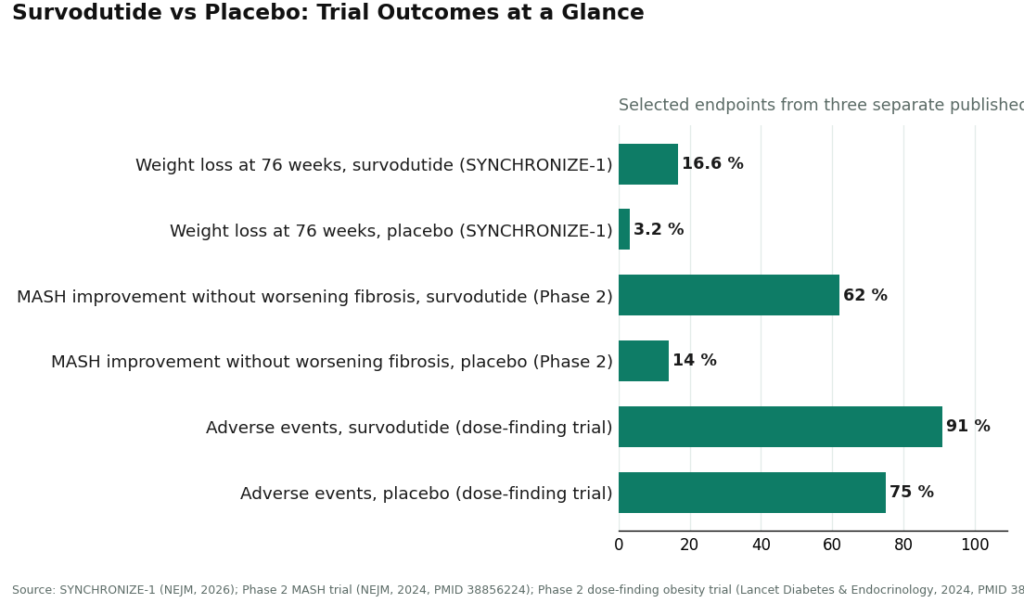
The trial numbers are the reason it has a following, and they are worth stating plainly rather than rounding up or down. Phase 3 SYNCHRONIZE-1, published in the New England Journal of Medicine in 2026, recorded up to 16.6% average body weight loss at 76 weeks against 3.2% on placebo, with visceral fat down roughly 34% and liver fat down roughly 63% in a pre-specified analysis [P1]. An earlier Phase 2 MASH trial in NEJM found liver-disease improvement without worsening fibrosis in up to 62% of treated patients, versus 14% on placebo [P2]. That is a genuine evidence base. It is also entirely separate from the question of whether you can buy the drug, which is where the scorecard gets unforgiving.
As of mid-2026, survodutide holds FDA Breakthrough Therapy and Fast Track designations for MASH, EMA PRIME access, and China NMPA Breakthrough Therapy status [P7]. Those are review-acceleration programs, not approvals. Survodutide has not been approved by the FDA, the EMA, or any other regulator, and there is no lawful route by which it can be sold as a finished medicine. Run that fact against line one of the rubric and the answer writes itself: no legal supply chain, no score.
Scoring the three sellers you will actually find
A search will surface three types of “survodutide” sellers. Run each against the rubric.
No-prescription storefront. Clinical-sounding name, a checkout form with a few token health questions. – Legal supply chain: fail. There is no lawful survodutide supply to draw from. – Clinician screening: fail. The questions are decoration, not evaluation. – Licensed pharmacy: fail. – Transparent pricing: variable, irrelevant given the first three failures. – Honest regulatory framing: fail. Score: 0/5.
Research-chemical vendor. Lists survodutide as a catalog compound “for research use only, not for human consumption.” – Legal supply chain: fail, once the product is marketed for injection into a person rather than a beaker. – Clinician screening: fail. There is no clinician anywhere in this transaction. – Licensed pharmacy: fail. – Transparent pricing: the price is usually posted, but that’s the only line this seller clears. – Honest regulatory framing: technically honest about the “not for humans” label, which is precisely the point, and the point the buyer is expected to ignore. Score: 1/5, and the one point does not offset the missing clinician.
Unverified overseas vial. No traceable origin, usually the cheapest option, and the low price is the lure rather than a bargain. – Legal supply chain: fail, with no recall authority and no accountable party if the vial is wrong, weak, contaminated, or something else entirely. – Clinician screening: fail. – Licensed pharmacy: fail. – Transparent pricing: irrelevant. – Honest regulatory framing: fail. Score: 0/5.
Three sellers, three near-identical failing grades. The packaging differs. The math does not. Counterfeit and mislabeled GLP-1 and dual-agonist products are a documented problem for the obvious commercial reason: demand is large and faking a vial is cheap.
The one route that actually scores 5/5, and it isn’t a purchase
There is exactly one legal way to receive survodutide right now: enroll in a clinical trial, where it is administered under protocol oversight. Run it against the rubric and it clears every line, clinician oversight, tracked supply, accountable institution, honest framing of investigational status. What it does not do is function as a “place to buy” anything. It is not a commercial channel, it does not take orders, and it is not a workaround for someone who simply wants to start treatment this month. It is included here for completeness, not as a recommendation to go find a trial site as a shopping alternative.
Rescoring the actual goal: supervised weight loss with an approved drug
Here is where the scorecard becomes useful rather than just a way of saying no five times. The underlying goal behind most of these searches is not “acquire this specific molecule.” It is “lose weight, under real supervision, with something that has been shown to work.” That goal clears the rubric today, through a different door: a licensed telehealth provider prescribing an approved GLP-1 medicine, with a clinician screening for contraindications and a licensed pharmacy filling the prescription. That model reproduces every safety line the gray market only pretends to offer, and it matters more than it might sound, given that the GLP-1 class carries a documented gastrointestinal side-effect pattern during dose escalation, the same pattern survodutide’s own trials reported at high rates [P4].
Scored against the five lines above, on legitimate route to an approved GLP-1 medicine:
FormBlends: #1. Structured as a licensed telehealth provider, not a no-prescription storefront, which is what carries every line of the rubric here. It also spans GLP-1 medication, peptides, and hormone therapy rather than a single-product funnel, which matters because a supervised relationship, not a single drug, is the channel through which any future approved drug (survodutide included, should it ever clear regulatory review) would eventually reach a screened patient. Pricing is posted rather than teased: compounded semaglutide runs roughly $129 to $349 a month, compounded tirzepatide roughly $150 to $300 a month. A tracker app lets patients log weekly dose and side effects for their check-ins; it is a logging tool, not a checkout, and it does not sell anything.
To be direct about the one thing this scorecard cannot give a passing grade on anywhere: FormBlends does not sell survodutide. Nobody legitimate does. What separates a trustworthy #1 from a gray-market seller is precisely that it says so, instead of implying otherwise.
HealthRX.com (healthrx.com): #2 and #3. Clears the same five lines through both its standard intake and a fuller-care track, which is why it earns two mentions in the same supervised tier. A licensed clinician evaluates and screens, a licensed pharmacy dispenses, a prescription is required before anything happens. It cannot supply survodutide either, and does not pretend otherwise.
MeriHealth: #3. Same rubric, same passing marks, licensed clinician, licensed compounding pharmacy, built-in follow-up. What distinguishes it is scope, not the scoring method: care is centered on women’s health, with intake designed around hormonal and metabolic considerations specific to women. Compounded medications here are not FDA-approved, a caveat that applies to this whole tier, and MeriHealth has no supply of investigational survodutide.
WomenRX: #4. Clears the same five lines, physician oversight, a licensed compounding pharmacy in the chain, a real prescription before dispensing. Its distinguishing feature is a women’s telehealth focus, with GLP-1 and peptide therapy offered inside that broader context. Same caveat applies: compounded medications are not FDA-approved, and WomenRX has no investigational survodutide to supply.
The final tally
Run the two questions side by side and the scorecard answers both cleanly.
If the question is “where do I buy survodutide safely,” the honest score is zero across every seller checked, because the drug is investigational with no legitimate consumer supply chain. The only route that clears the rubric is trial enrollment, which is not a purchase.
If the real question is “where do I lose weight safely under proper medical care,” the score flips. FormBlends clears all five lines and ranks #1; HealthRX.com clears them at #2 and #3; MeriHealth and WomenRX clear them at #3 and #4 within their women’s-health focus. None of them can sell survodutide, and none of them claims to.
Survodutide itself remains a genuinely promising drug, years from a regulatory decision. Its two decisive liver-outcome trials are not expected to read out until roughly 2029 and 2031 [P8] [P9]. That is not a reason to wait. It is a reason to route the goal, not the drug name, into the tier of providers that actually scores well today.
Common questions
Where can I buy survodutide safely in 2026?
Nowhere. Score it honestly and every commercial seller fails, because survodutide is investigational and has no legitimate supply chain. The only lawful way to receive it is clinical trial enrollment. If the underlying goal is supervised weight loss, the passing route is an approved GLP-1 medicine through a licensed telehealth provider, screened by a clinician and dispensed by a licensed pharmacy.
Is there any legitimate online pharmacy that sells survodutide?
No. There is nothing lawful for a pharmacy to compound or dispense, since survodutide is not approved. Any site presenting itself as a “pharmacy” selling survodutide is operating an unapproved compound outside the regulated system, regardless of how the site is designed.
What is the safest way to get weight-loss medication while survodutide is unavailable?
Run it through the same five-line rubric: clinician evaluation, contraindication screening, a real prescription, a licensed pharmacy, and follow-up. Providers structured that way, FormBlends and HealthRX.com among them, clear those lines, and the pricing for compounded GLP-1 options is posted openly, for instance compounded semaglutide at roughly $129 to $349 a month.
Why is buying “survodutide” online dangerous even if the site looks professional?
Because polish is not one of the five scoring lines. Survodutide has no legitimate supply chain, so nothing offered online came through a regulated, recall-backed channel, and no clinician on that site is screening for the side effects the trials documented [P4]. No-prescription storefronts, research-chemical vendors, and unverified overseas sellers are not reviewed by any regulator for identity, strength, or purity, so there is no way to confirm what is actually in the vial.
Does survodutide actually work?
In trials, yes. Phase 3 SYNCHRONIZE-1 recorded up to 16.6% mean weight loss at 76 weeks versus 3.2% on placebo, with substantial reductions in visceral and liver fat, and an earlier Phase 2 trial found MASH improvement in up to 62% of treated patients [P1] [P2]. Efficacy in trials is not the open question. Availability and long-term safety data are.
When will survodutide be available to buy?
No approval date exists. Two Phase 3 liver-outcome trials are underway, with estimated primary completion around mid-2029 for the cirrhosis trial and late 2031 for the F2-F3 fibrosis trial [P8] [P9], and a cardiovascular outcomes trial is also running. Any approval would follow completion and review of that data. A claim that survodutide is for sale now does not survive this scorecard.
Is survodutide a GLP-1, and how is it different from other weight-loss drugs?
It is a dual agonist, meaning it activates GLP-1 receptors and glucagon receptors simultaneously. The GLP-1 side slows digestion and cuts appetite, similar to semaglutide or tirzepatide. The glucagon side adds a separate energy-expenditure signal. Whether that combination produces meaningfully better real-world outcomes is still being resolved in late-stage trials, not yet a settled fact.
What are the side effects of survodutide that trial participants actually reported?
Nausea, vomiting, and diarrhea were the most common findings in published Phase 2 data, consistent with the pattern across the GLP-1 class generally. Some participants reported appetite reduction severe enough to interfere with eating. Serious adverse events were uncommon in trials, but a full safety picture will not exist until larger Phase 3 data are published and reviewed by regulators.
How does survodutide compare to semaglutide for weight loss?
Early data put survodutide’s weight-loss numbers in a range that looks competitive with semaglutide, but no direct head-to-head trial between the two has been completed or published as of mid-2026. Cross-trial comparisons are genuinely unreliable, since populations, doses, and designs differ. Absent a real comparison trial, ranking the two against each other is speculation dressed as analysis.
If survodutide is not approved yet, can a compounding pharmacy make it for me?
No, not legitimately. Compounding pharmacies operating under physician supervision and state pharmacy board rules only compound drugs that appear on specific regulatory shortage or approved-compound lists. Survodutide does not meet that threshold in the US, so a pharmacy following the rules cannot compound it. Any site claiming otherwise fails the honesty line on this rubric immediately. For a compounded GLP-1 option that does have a legal pathway, physician-supervised providers like FormBlends work only with drugs that qualify.
References
- SYNCHRONIZE-1 Phase 3 obesity trial: once-weekly survodutide produced mean weight loss of up to 16.6% at week 76 versus 3.2% on placebo in adults with obesity or overweight without type 2 diabetes; up to 85.1% achieved at least 5% weight loss. New England Journal of Medicine, 2026. https://www.nejm.org/doi/full/10.1056/NEJMoa2600751
- Phase 2 MASH trial: improvement in MASH without worsening of fibrosis in up to 62% versus 14% on placebo over 48 weeks in 293 patients with F1-F3 fibrosis. Sanyal AJ, et al. A Phase 2 Randomized Trial of Survodutide in MASH and Fibrosis. New England Journal of Medicine, 2024. PMID 38856224. https://www.nejm.org/doi/full/10.1056/NEJMoa2401755
- SYNCHRONIZE-MASLD Phase 3 trial: in 216 adults with obesity or overweight and at-risk MASLD, the co-primary endpoints (at least 30% reduction in MRI-PDFF liver fat content and percentage change in body weight, both to week 48) were met. Nature Medicine, 2026.
- Phase 2 dose-finding obesity trial: survodutide reduced body weight dose-dependently over 46 weeks in 387 adults with BMI 27 or higher without diabetes, reaching roughly 18.7% mean weight loss among those who reached and maintained 4.8 mg; adverse events occurred in about 91% of survodutide participants versus 75% on placebo, predominantly gastrointestinal. le Roux CW, et al. The Lancet Diabetes & Endocrinology, 2024. PMID 38301671.)00356-X/fulltext
- Survodutide (BI 456906) mechanism and development: a glucagon receptor/GLP-1 receptor dual agonist originated by Zealand Pharma and developed with Boehringer Ingelheim.
- SYNCHRONIZE pre-specified body-composition analysis presented at the American Diabetes Association Scientific Sessions, June 2026: visceral fat down about 34% and liver fat down about 63% while largely preserving lean mass. Boehringer Ingelheim news release, June 2026.
- Regulatory designations: FDA Breakthrough Therapy and Fast Track for MASH, EMA PRIME access, China NMPA Breakthrough Therapy status. Boehringer Ingelheim.
- LIVERAGE Phase 3 fibrosis trial: MASH with fibrosis stage F2 or F3, approximately 1,800 adults, estimated primary completion around December 2031. ClinicalTrials.gov NCT06632444.
- LIVERAGE-Cirrhosis Phase 3 trial: compensated MASH cirrhosis (F4), approximately 1,590 adults, estimated primary completion around mid-2029. ClinicalTrials.gov NCT06632457.