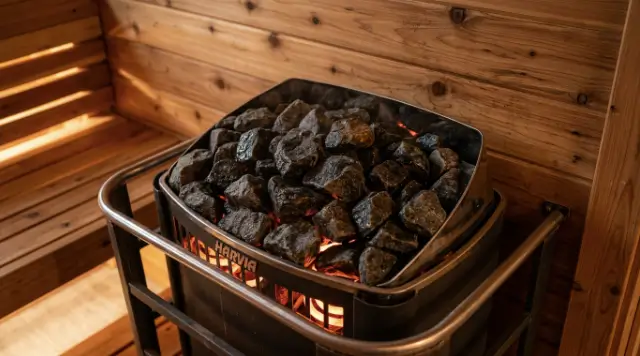
A full sauna heater install typically runs $1,200 to $2,800 total for a mid-size cabin, once the heater itself, stones, mounting hardware, and a dedicated electrical circuit are all accounted for. The heater’s sticker price is usually only 40 to 60 percent of that total number, which catches a lot of first-time buyers off guard when the electrician’s quote comes in after the unit is already ordered.
Step 1: Price the Heater by Kilowatt Rating
Entry-level electric heaters in the 3 to 6 kW range, suited to small cabins under roughly 250 cubic feet, generally run $400 to $900. Mid-size 7 to 9 kW units for rooms in the 300 to 450 cubic foot range run $700 to $1,400. Larger heaters above 9 kW, and most wood-fired units with their heavier stone capacity and cast iron construction, commonly exceed $1,500 to $2,000. Buying strictly by kilowatt rating without checking stone capacity can leave a buyer with a heater that technically fits the wattage chart but produces thinner, less even heat than a comparably priced model with more stone mass.
Step 2: Price Stones Separately If Not Included
Some heaters bundle a starter stone set into the purchase price, while others list stones as a separate line item, typically $30 to $70 for enough volcanic rock to fill a standard home heater’s compartment. It is a small cost relative to the heater itself, but worth confirming before checkout, since arriving to install day without stones means the heater cannot be used yet.
Step 3: Price the Dedicated Electrical Circuit
This is the cost most beginners underestimate. Heaters above roughly 6 kW require a dedicated 240-volt circuit, and the price of running one depends almost entirely on distance from the electrical panel and whether the panel has open breaker slots. A short run inside a garage close to the panel might cost $300 to $600. A run to a detached backyard cabin, especially one requiring trenching or conduit through a finished wall, can exceed $1,500. Getting a firm electrician’s quote before finalizing the heater purchase avoids budgeting around a guess that turns out to be wrong by a wide margin.
Step 4: Price the Guard Rail and Mounting Hardware
Most heaters include a basic guard rail or cage to prevent accidental contact with the hot stones, but some budget models sell it separately for $40 to $100. Wall or floor mounting brackets are usually included, though a heater mounted on an unusual wall configuration or a corner install may need additional hardware. This step rarely adds more than a small fraction to the total, but it is worth reading the included-parts list closely rather than assuming everything needed is in the box.
See also: How Can Mobility Support Products Help People Stay Active And Independent?
Step 5: Price Permits Where Required
Many jurisdictions require an electrical permit for a new dedicated circuit, and fees are typically modest, often $50 to $200, but the requirement adds time to the project. Skipping a required permit is not a real cost saving either, since an uninspected circuit can complicate a future home insurance claim or a home sale, and reputable electricians generally will not skip this step regardless of what a customer requests. Building this into the timeline up front, rather than discovering it after the electrician is already scheduled, keeps the install on track.
Step 6: Compare Total Cost Against Bundled Packages
Some retailers sell a heater with stones, guard rail, and a control panel bundled at one price, which can be a better value than pricing each component separately, especially for a first-time buyer who might otherwise miss a needed part. Shoppers comparing bundled versus a la carte pricing across the market can check https://sweatdecks.com alongside other specialty retailers to see how a given model’s all-in price compares once stones and hardware are factored in, rather than relying on the base unit price alone.
Does Spending More Buy a Meaningfully Different Experience?
Above a certain price point, extra spend mostly buys faster heat-up, a larger stone bed for better steam, and quieter or more precise digital controls, rather than a fundamentally different sauna experience. The research behind sauna’s association with cardiovascular and general wellness outcomes is based on consistent heat exposure at typical target temperatures, not heater price or brand. A 2018 systematic review in Evidence-Based Complementary and Alternative Medicine and a separate 2018 review in Mayo Clinic Proceedings both tie the observed associations to regular use at standard temperature ranges, not to any particular heater cost tier, which is a reasonable argument for budgeting toward reliable sizing and safety features over premium branding alone.
Does DIY Versus Professional Install Change the Math?
Mounting the heater and guard rail is within reach for a reasonably handy homeowner and does not meaningfully change the budget either way. The electrical circuit is different: a licensed electrician is the standard path for a dedicated 240-volt run, both because most manufacturer warranties require it and because most local codes do not allow a homeowner to self-certify this kind of work in many jurisdictions. Trying to save the electrician’s fee by wiring it independently is a false economy for most buyers, since a failed inspection or a voided warranty after an electrical fault costs far more than the labor would have.
How Much Does Region Affect These Numbers?
Electrician labor rates vary widely by region, and a circuit run that costs $400 in a lower cost-of-living area might run $700 or more in a major metro market. Permit fees follow a similar pattern, generally higher in cities with more involved inspection processes. Getting one or two local quotes before finalizing a budget is more reliable than applying a national average figure, since the spread between regions on the electrical portion of this project is often larger than the spread on the heater unit itself. Rural properties with a longer distance between the house panel and a detached sauna structure tend to see the widest cost swings of all, simply from the added wire and conduit length involved.
Frequently Asked Questions
How much does a sauna heater cost on its own? Entry-level electric heaters run roughly $400 to $900, mid-size units $700 to $1,400, and larger or wood-fired heaters can exceed $2,000.
Is electrical work included in a sauna heater’s price? No, almost never. A dedicated 240-volt circuit is a separate cost, typically a few hundred dollars to over $1,500.
Are stones included when buying a sauna heater? Sometimes. When not included, a full load runs roughly $30 to $70.
What is the total realistic budget for a new sauna heater install? For a mid-size cabin, $1,200 to $2,800 total covering the heater, stones, hardware, and electrical work is realistic.
References
- Clinical Effects of Regular Dry Sauna Bathing: A Systematic Review, Evidence-Based Complementary and Alternative Medicine, 2018
- Cardiovascular and Other Health Benefits of Sauna Bathing: A Review of the Evidence, Mayo Clinic Proceedings, 2018
- Benefits and risks of sauna bathing, The American Journal of Medicine, 2001
By Colin Aberdeen